As a landscape designer, I routinely hear clients requesting a “low maintenance” solution to their landscape. In some cases, even a “no maintenance” landscape. Well, I can work with the “low” but not the “no”. And, how “low” can you really go when it comes to landscape maintenance? That sounds like a riddle.
All landscapes require some maintenance in order to look and perform their best. Even landscapes that re-introduce and reclaim the native prairie species, which thrived undisturbed for thousands of years, aside from the the large buffalo herds and wildfires, need initial maintenance and encouragement to get established. But it is a good idea to make some key decisions in planning your landscape project in order to limit or manage the amount of maintenance required, and then start by following some basic care instructions.
First and foremost, two important factors of achieving low maintenance are determined by the selection of plant material, and the type of mulch used in the planting beds. Plants need to be carefully selected for their hardiness, culture, and growth habits to enable their success and the amount of supplemental care required. Soil characteristics range dramatically throughout the Twin Cities, from the heavier prairie, forest, and bog-derived soils that are often compacted during home construction, to the lighter, less-fertile sand deposits throughout the north and northwest suburbs. Each setting also has a range of micro-climates, where plants receive varying exposures to sunlight, wind, water, and wildlife. So, it is wise to consult with a trusted expert to design your garden with plants that are best suited to your site, with knowledge of soil amendments and irrigation needs, in order to get the best success of your home landscape.
The type of rock or bark mulch used to cover the planting beds is also critical. Rock and bark mulches are both attractive groundcovers. They serve to prevent erosion, maintain moisture and air exchange in the soil, and suppress weed growth. From a maintenance standpoint, my experience has shown that a 3” bed of decorative rock with an underlayment of professional-grade polypropylene fabric makes the best maintenance solution. Rock will not have to be regularly reapplied like mulch, and with a carefully installed polypropylene blanket it should retard the growth of weeds while allowing water, air, and applied fertilizers or pre-emergents to make contact with the soil.
However, fabric-underlain rock or mulch can limit the fullness and density of your garden and limit your selection of plants. It can be more aesthetic to use shredded bark mulch and load your beds with a wider array of shrubs and perennials. What you might gain in aesthetic you might also gain in maintenance, but it is often well-worth it.
Maintaining your trees and planting beds does not have to be a daunting task, but it could be a worthy investment to hire a qualified master gardener or gardening service to assist you. However, if you know some general information on watering, feeding, grooming and pruning, fending off the wildlife, and dressing up for the winter, you can get off to a good start.
Here are the most important fundamental aspects of caring for your property and ensuring the success of your new landscape, in the following categories, assuming that I have worked on your project and have installed a new landscape:
1. Watering
2. Feeding
3. Grooming and Pruning
4. Fending off Wildlife
5. Dressing up for the Winter
Watering is vital. Water is the element of all life, and like all things, if plants do not have enough, they die, and if they have too much, they die. On your project, I would plan for this from the beginning by using “companion plants,” or plants that generally need the same soil and water requirements, and those that are more tolerant of drought-like conditions. In this case, it will be good for your lawn and landscape to “dry out” in between watering cycles. The general rule is less frequent but more thorough watering.
However, your landscape is on an automatic watering system and will be able to be managed for the times when the weather conditions fluctuate and do not give the plants quite enough water, or if the rains become more frequent and the watering system should be greatly reduced or shut off to account for the additional water. The irrigation system, by and large, should supplement for the water needs of your landscape. This is managed in the time set on the clock, and with the rain sensor attached to the irrigation system. Yet, it may require that you periodically look for signs in the plants and check for the moisture level of the soil if conditions do arise.
Too much water? When plants are beginning to get too much water they tend to show it by looking weak and having yellowing leaves toward the interior sections of the plant, and might begin to defoliate in those areas. Some of the leaves might also curl and have a “leathery” feel to them. In this case, check the moisture around the plant by sticking your fingers in the soil underneath them, and compare notes with how much rain the site has received in recent days and what the watering schedule currently is, and how the irrigation coverage is. In this case, you might want to scale back, or even turn off the irrigation system, for a few days. Let the soil around the plants dry out for a few days, and then resume a regular watering schedule again.
Too little water? When plants are getting too little water they tend to yellow, wilt or brown on the ends of the plants, and have a “crispy” feel to them as they defoliate.
In case of the lawn, it will start to go into summer dormancy, as it is a cool season grass (most of the green growth happens in the cooler times of the spring and early summer, and then in late summer and fall) . So, the lawn will benefit from some additional water which has been adjusted on the clock, and watering for the turf areas should increase automatically for the months of July and August, as well as with a slight increase in the drip irrigation to the plants.
However, please check the moisture, the time, and the Seasonal Adjust on the clock, to ensure that the watering is scheduled properly.
Feeding lawn and plants is not critical unless there is a diagnosed deficiency tested in the soil or indicated in the plant. Easy soil test kits are available in most retail garden stores. In some instances, fertilizer might adversely alter the growth and bloom for some perennials that are naturally acclimated to infertile soils, or might encourage a level of dependency that can prevent them from strengthening, taking root, and gathering their own nutrients from the soil as they brace for the next winter. In the case of your landscape, the plants are generally going to go fine without fertilizer. However, fertilizer in the time when plants are getting ready to bloom can increase vigor and the production of blooms.
It might be a good thing to periodically fertilize. There are recommendations for this, based on the plant selection and the situation with pets and wildlife that you have at your home.
Lawn: If lawns are being irrigated throughout the hot summer months, they normally require more nitrogen fertilizer in the form of ammonium or nitrate. For higher maintenance lawns, two to three applications of one pound of nitrogen per 1000 sq. ft. are required to maintain constant growth. If three applications are made, apply in mid-May, late August and mid-October. Be sure to irrigate immediately following fertilizer application. This prevents burning of the lawn under moist conditions and decreases the chance of it to get carried away in runoff. Nitrogen fertilizers for lawns are marketed as “turf builder”, “turf food”, or “winterizer” and should contain no phosphorous. The second number in the composition, such as 27-0-14, should be zero. In fact, it is considered illegal to use phosphorous fertilizer that is broadcasted for established lawns in Minnesota due to the adverse affects it has with feeding algal blooms that will deplete the water of oxygen for aquatic life. In your case, you will likely have much more pronounced algae growth anywhere that water might collect for any prolonged period of time around your home.
Trees, Shrubs, and Perennials: For trees, shrubs, and perennials, wait until the second year after they are planted before fertilizing. All plants can be periodically fertilized as they are actively growing, but plants should not be fertilized after August 15 in order for them to harden and prepare for winter. Generally, most trees and shrubs are grown for their foliage and structure, and a basic 10-10-10 fertilizer works well. Some are grown for their beautiful flowers and will benefit from extra phosphorous, so something like 10-20-10 works better for them.
Trees will often indirectly receive nitrogen fertilizer from the lawn. But it is better to supplement them with time-released fertilizer that includes phosphorus. Do this by drilling holes 6-9” deep spaced around the drip line (right at the edge of the canopy) and apply doses of the fertilizer, or use fertilizer stakes. Applying a tablespoon a balanced time-release fertilizer to each hole is a good way to fertilize the tree.
There are several types of fertilizers on the market in the form of liquid, granular, or water-soluble crystals. There are excellent organic fertilizers on the market as well, such as Milorganite, Renaissance, and Sustane.
In your landscape, the best and most simple fertilizers that I would recommend is spreading Preen N Green around the plants as a pre-emergent in the spring (late April) and then again in early summer (early June) as a way to mitigate annual and biennial weeds and add a boost of time release fertilizer.
Also, you can add Milorganite around the plants in order to give them a mild dose of added Nitrogen, a few times a season until early August. Milorganite also has been alleged to discourage deer, as it is derived from organic material and acts as a repellent. Also, Milorganite can be added to your lawn regime and broadcasted over the turf areas as way to add Nitrogen fertilizer and also try to discourage deer.
Grooming and pruning your landscape is where the labor can feel overwhelming for some homeowners. But the process of caring for your landscape does not have to be done at near the frequency of mowing the lawn.
Lawns should be moved at two to three inches, and with no more than one-third of the height being mowed at one time. Rather than just planning to mow your lawn every Saturday or Sunday, check with how fast the lawn is growing too see if you can skip a few days or if you need to do it a few days earlier.
From a maintenance standpoint, all lawn and bedding areas can benefit from the periodic employment of pre-emergents that keep weed seeds from germinating. A very effective organic pre-emergent is Corn Gluten Meal, which was developed at Iowa State University ten years ago and is now marketed by about a dozen companies. Some forms are also blended with organic fertilizers as a “weed and feed”. It is more user friendly as a granular form, which can be found on the market.
Pre-emergents should be applied to lawns in early spring when the bulbs are in bloom, and then for dandelions and fall-germinating weeds from about August 15 to September 15. Pre-emergents can be applied to garden areas once all bedding plants are established and are emerging for the season by carefully broadcasting it onto the soil between your plants, boulders, and along the foundation, lightly raking it into the soil or last-year’s mulch, and then watering. Pre-emergents could then be reapplied later in the summer or when the mulch is freshened up, but follow instructions on the package and monitor the growth of new weeds as you spend time outdoors.
In the area of rampant weed growth in the lawn, or where you want to salvage and reclaim a lawn area, it can be possible to do regular treatments of weed and feed in a granular form, or with a hose attachment like Weed B Gone Max, to routinely treat the weedy species growing in the lawn and to encourage the turf species to grow more vigorously. This has proven very successful for people that I have talked with, who have reclaimed weedy areas into a nicer blend of turf grasses when the area has been over-seeded with a blend of bluegrass and fescue grasses to enable the new turfgrass to blend should start to compete with the weedier grasses.
For pruning basics, there are varying techniques for different types of deciduous and evergreen shrubs. In some cases it is for renewal growth, in other cases it is to head back the plant into a more compact size, and still in other cases it is to control the growth rate. It is best to check with the specific plants you intend to prune.
Generally, if trees or shrubs bloom early in the season on old wood they should be pruned immediately after they finish blooming (i.e., serviceberry, black chokeberry, crabapple tree, lilac). If flowers are formed in late spring or summer, they should be pruned in early spring before the new growth starts, or sheared immediately after bloom (i.e., spirea, weigela). Shrubs that bloom on new woody growth or shrubs grown primarily for their foliage, fruit, or other non-flowering reasons should only be pruned in the spring before new growth starts (i.e., ninebark).
Pruning evergreens can be done to remove browned areas, to restrict growth, and for shaping. For the plants that might sustain some winter burn, wait until new growth has flushed out to remove the browned areas, as it might be at least partially obscured by the new growth. For ornamental pines, when their spring candles and mature to full size, cut them in half to stunt their growth. For other plants that you want to shape, wait until new growth has started in early spring and shear the ends to encourage dense lateral growth to keep them think and bushy. You can shear a few times a year if you would like to maintain a specific look. However, some evergreens maintain a nice, natural tight growth habit on there own.
Fending off Wildlife: Deer, rabbits, squirrels, voles, mice, and a host of other critters can be common visitors and potential nuisances in your home landscape. Again, the greatest strategy for this, especially for deer, was in the selection of plant material. There are lists of “deer resistant” plants available that were cross-referenced and used as a guide for selecting the plants deer consider undesirable. Though the list is not completely reliable, I have personally found them to seek out and eat a specimen not on the list, among the many “deer resistant” plants they trampled along the way. (This might be the case for daylily blooms and hosta.) So it is good to also employ other tactics when necessary.
The ways to discourage or remedy wildlife invaders are: plant selection, odor, taste, noise, barriers, and traps. No solution is a guarantee, as deer and other critters might put up with foul order or taste in order to keep from starving when food is scarce, and fence barriers or alarms are usually impractical
Rabbits, voles and other critters can be even more difficult. It is always best to first check the evidence and clues to determine the problem. For instance, deer and rabbits bite off and eat portions of the plants, squirrels will remove large blooms and twigs and leave evidence behind, and voles and mice will gnaw through bark below the snow line while rabbits do similar damage above the snow line. Moles will leave raised trenches throughout the lawn as they look for worms and grubs. Try to determine the cause before deciding on a solution.
When moles are present, it could be a sign that you have a grub problem, and by treating the yard for grubs you might also discourage the mole problem.
Here are some repellents worth trying:
For deer and rabbits: Milorganite fertilizer; Liquid Fence; Deer-Away containing putrescent egg solids; Hinder containing ammonium soaps; Irish Spring deodorant soap for deer (it works for Pine Tree Apple Orchard); and moth balls for rabbits.
For voles and mice: Repellex Root Saver liquid form containing castor oil, soap, potassium sorbate, and paprika; Repellex Root Saver granular form containing garlic oil, castor oil, paprika, and wintergreen oil; Liquid Fence Mole and Vole Repellent. Or, if you decide to kill voles, use Rozol Rat and Mouse Killer pellets, or place mouse traps baited with apple slices in an upside-down coffee can at intervals along their active routes.
Dressing up for the winter: If you decide to add plants and they are listed for zone 4b or zone 5, beware! Not all plants sold commercially in the Twin Cities are truly hardy for Minnesota. But with certain precautions, you might have some luck. It is often a good idea to purchase plants that are “Minnesota Grown” which means they have already tolerated a winter around here. However, other plant varieties brought in from other zone 3 and 4 regions can also perform well.
For plant establishment within the first two growing seasons, it is good to make sure that the plants go into the winter with moisture in the soil. Often times, there is a lapse between when irrigation systems are shut down to when the first significant precipitation occurs in the form of rain or snow. So in some cases, it is a good idea to hand water around the plants in the late fall, and let the soil freeze with moisture around the plants.
Most perennials can be cut back after the first killing frost and cleaned up. In some cases, the crowns of the plants insulated with a layer of mulched leaves late in the fall to protect them from excessive freeze-thaw cycles. However, in the landscape has generally hardy plants, this may not be required. The mulch should then be removed right away in the spring. Evergreens prone to winter burn (dwarf pines, arborvitae, junipers) can be solar screened with burlap to shade and screen from winter winds. Burlap or plastic could also be used to create an insulated blanket of mulched leaves around the base of marginally hardy plants that are prone to winter damage. To prevent sun scald, especially in maples, a tree wrap should be used around the trunk to compensate for its thin bark. So, just as Minnesotans need coats, some landscape plants need a little insulation as well.

Landscape Design Studios, "Inside the Studio" -- The official "Design Journal" of Landscape Design Studios LLC, as maintained by David Sonka on behalf of Jack Dorcey and our company. I hope to show you, our friends, family, and clients, some snapshots of our work through the progression of the landscape season, and the questions and answers that arise in the process of being a professional landscape designer.

Tuesday, July 20, 2010


Sunday, July 4, 2010
Happy 4th of July! Hope you enjoy your independence, like I enjoy mine.
Fellow subjects... er, I mean citizens (Thomas Jefferson's revision of American vernacular, made with one fell swoop of ink on the original Declaration of Independence; http://www.cbsnews.com/stories/2010/07/02/national/main6641548.shtml), it is great to have a weekend such as this when we can celebrate the birth of our country, and to take a much-needed break from working a busy summer. This tends to serve as the "halfway point" in our household, with me working in the landscaping and construction industry, and with my wife being a school teacher whose summer is starting to approach the mid point. In Minnesota, most kids go to school into the first week of June, and then return after Labor Day. However, her schedule of duties pick up again in early August. July 4th is her reminder to "get out and enjoy summer while it lasts."
It is great to be independent, and to celebrate the independence that was granted to us by the Continental Congress of the first 13 colonial states, on July 4, 1776, ensuing a battle for our freedom from the British Empire which would last until the Treaty of Paris was signed on Sept. 3, 1783.
With the valour that was seen by the Continental Army under the direction of General George Washington, marching his troops for hundreds of miles, engaging in bloody battles, setting up winter camps and erecting complex bunkers while they endure the harshest of winter conditions at Valley Forge and Morristown, NJ,... it is easy to overlook the strength and power that was brought to us when we formed alliances. These alliances became significant factors in our success in routing the British and ensuring our independence.
On February 6, 1778 the French Alliance was signed and we formally teamed up with France (France had already been giving us support in money and munitions in assistance with the Dutch) and their maritime war with the British tied up portions of their fleet, just as their wars with the British in the West Indies, India, and other regions of the world tied up some of their resources. The French also sent 6,000 troops over to fight with the Continental Army on land in 1779 and 1780, in addition to their naval fleet, which played key roles in the latter battles that helped cut off British supply lines and lead to the surrounding of Cornwallis in the Seige at Yorktown. In 1779, Spain had also aligned with France and continued their battle with the British at sea, with France and Spain also threatening an attack directly upon the British homelands. These combined threats aided the efforts of the United States of America in attaining its victory and its independence, and helped to set the course of history.
Good alliances can play a key role in overcoming a enormous challenges and bringing about success. In what we do at Landscape Design Studios, our good alliances are our great network of contractors, our Associated Contractors, who have proven time and time again to bring a good value, a great professional workmanship, and a good record of accountability to help ensure the success of our projects, and the success of Landscape Design Studios. It is a great priviledge to work with them, and it would be a great satisfaction to continue to work together and stay busy for the rest of the summer. We will continue to try and do our part to make 2010 a busy year, and a great success for everyone! Thank you!
Thank you, also, to the brave men and women who stood up to tyranny and injustice, and our allies in France, Spain, the Netherlands, and some key Native American tribes, who helped us as we declared and fought for our independence with valour and sacrifice, as we secured our independence as the United States of America..
Sincerely,
Dave


It is great to be independent, and to celebrate the independence that was granted to us by the Continental Congress of the first 13 colonial states, on July 4, 1776, ensuing a battle for our freedom from the British Empire which would last until the Treaty of Paris was signed on Sept. 3, 1783.
With the valour that was seen by the Continental Army under the direction of General George Washington, marching his troops for hundreds of miles, engaging in bloody battles, setting up winter camps and erecting complex bunkers while they endure the harshest of winter conditions at Valley Forge and Morristown, NJ,... it is easy to overlook the strength and power that was brought to us when we formed alliances. These alliances became significant factors in our success in routing the British and ensuring our independence.
On February 6, 1778 the French Alliance was signed and we formally teamed up with France (France had already been giving us support in money and munitions in assistance with the Dutch) and their maritime war with the British tied up portions of their fleet, just as their wars with the British in the West Indies, India, and other regions of the world tied up some of their resources. The French also sent 6,000 troops over to fight with the Continental Army on land in 1779 and 1780, in addition to their naval fleet, which played key roles in the latter battles that helped cut off British supply lines and lead to the surrounding of Cornwallis in the Seige at Yorktown. In 1779, Spain had also aligned with France and continued their battle with the British at sea, with France and Spain also threatening an attack directly upon the British homelands. These combined threats aided the efforts of the United States of America in attaining its victory and its independence, and helped to set the course of history.
Good alliances can play a key role in overcoming a enormous challenges and bringing about success. In what we do at Landscape Design Studios, our good alliances are our great network of contractors, our Associated Contractors, who have proven time and time again to bring a good value, a great professional workmanship, and a good record of accountability to help ensure the success of our projects, and the success of Landscape Design Studios. It is a great priviledge to work with them, and it would be a great satisfaction to continue to work together and stay busy for the rest of the summer. We will continue to try and do our part to make 2010 a busy year, and a great success for everyone! Thank you!
Thank you, also, to the brave men and women who stood up to tyranny and injustice, and our allies in France, Spain, the Netherlands, and some key Native American tribes, who helped us as we declared and fought for our independence with valour and sacrifice, as we secured our independence as the United States of America..
Sincerely,
Dave


Tuesday, June 22, 2010
June Cartoons
I am just getting back and settled from a 6-day fishing expedition and being relatively "off the grid" for a while in the sparse regions of Ontario (Wow, that was nice. Like my father-in-law says, it is better to take a little time away and spend a little money on an activity such as fishing, then to spend money on a regular basis to lay on a couch and tell someone all of your problems, when you get about the same results.)

John Lasseter is truly one the most creative minds, best story-tellers, and most innovative animators in the history of film making. Buzz, Woody, Jesse, Bullseye, Ham, Rex, and Mr. and Mrs. Potatohead have been prominent pieces of our kids' toy collection. They are loveable. And in Toy Story 3, the characters live on, and find their way to a new loving home, leaving a glimpse that the story line might still have yet to unfold.

It also just so happened that tonight, on CNBC, there was a biography on Lasseter and co., and the creation of Pixar into the Disney-Pixar Animation Studios that exist today. It showed the course of Lasseter, Dr. Alvy Ray Smith, Dr. Catmull, Steve Jobs, George Lucas, and the sequence of events that lead to pioneering computer development and software creation which lead to groundbreaking animation techniques, to CGI graphics, and to the pilot landmark film that was Toy Story, back in 1995.
It was pretty fascinating. But standing out in the group was the artist, cartoonist, and unique story-teller that is Lasseter. It was amazing to see how a creative mind and artist, and a man with an active child inside, can take on the next technology and develop it in order to further excel his ability to articulate his ideas. He, like me and others that I know, was the guy doodling caricatures and story lines in a notebook instead of taking notes in math or history class. He later was compelled to find ways to revolutionize the process of bringing his caricatures and stories to life, and reveal them in a way that has never been done before.
A guy like me can easily be inspired from somebody like Lasseter. Just 15 years ago I graduated from the 6-8th best Landscape Architecture program in the country, and learned it all the "old fashioned way" with hand drawings of pencil, ink pen, color pencils, watercolors, and markers, as well as doing physical models and collages. Just 5-6 years ago, I was still drawing and designing landscapes that way. While there really is nothing wrong with that, and it is a good way to come up with the best design as you work through a hands-on process, it might be an ineffective way to articulate the imagination that is in the design. The recent softwares offered can further enable that articulation, and it has been a challenge to sort through and come up with some techniques when largely doing it on my own. But I have figured some things out. And an inspiration like John Lasseter definitely encourages me to do and learn more, whenever possible, to advance that to the next level.




Sincerely,
Dave
However, upon returning, I found that the rain had continued on for days while I was gone, and further hampered progress on my construction site with a July 1st deadline. Ugh! While I have been doing this for a good 13-14 years, and I know that this is a fact of life, and I know that this kind of thing "just happens" in an outdoor business that requires next-to-perfect weather... it still irritates me and brings on the stress to no end. It is also a good thing when the client does seem to understand this fact and phenomenon as well. I am lucky to have such wonderful clients to work for on regular basis.

On Father's Day weekend, the big event in my household was seeing Toy Story 3, the long-awaited sequel to the movies that have become a rainy-day (or snowy-day) mainstay in our house since a short time after my son was born, which my younger daughter has also fallen in love with. I remember seeing Toy Story on VHS not long after it came out, and being thoroughly entertained and perplexed at how all of the "characters" and "rooms" in a cartoon have now taken on 3D shape and are casting shadows on the ground, and are seen moving through a room with realistic camera angles while the room stays still. It was revolutionary!
It is also one of those premises and evolving story lines that can evoke the imagination and entertain the young and old kids-at-heart alike. The premise of toys coming to life, having relationships, and living out complex scenarios on a day-to-day basis behind our backs and behind closed doors, toys all longing to be played with, having rivalries, and looking out for their owners... How ingenious!
John Lasseter is truly one the most creative minds, best story-tellers, and most innovative animators in the history of film making. Buzz, Woody, Jesse, Bullseye, Ham, Rex, and Mr. and Mrs. Potatohead have been prominent pieces of our kids' toy collection. They are loveable. And in Toy Story 3, the characters live on, and find their way to a new loving home, leaving a glimpse that the story line might still have yet to unfold.

It also just so happened that tonight, on CNBC, there was a biography on Lasseter and co., and the creation of Pixar into the Disney-Pixar Animation Studios that exist today. It showed the course of Lasseter, Dr. Alvy Ray Smith, Dr. Catmull, Steve Jobs, George Lucas, and the sequence of events that lead to pioneering computer development and software creation which lead to groundbreaking animation techniques, to CGI graphics, and to the pilot landmark film that was Toy Story, back in 1995.
It was pretty fascinating. But standing out in the group was the artist, cartoonist, and unique story-teller that is Lasseter. It was amazing to see how a creative mind and artist, and a man with an active child inside, can take on the next technology and develop it in order to further excel his ability to articulate his ideas. He, like me and others that I know, was the guy doodling caricatures and story lines in a notebook instead of taking notes in math or history class. He later was compelled to find ways to revolutionize the process of bringing his caricatures and stories to life, and reveal them in a way that has never been done before.
A guy like me can easily be inspired from somebody like Lasseter. Just 15 years ago I graduated from the 6-8th best Landscape Architecture program in the country, and learned it all the "old fashioned way" with hand drawings of pencil, ink pen, color pencils, watercolors, and markers, as well as doing physical models and collages. Just 5-6 years ago, I was still drawing and designing landscapes that way. While there really is nothing wrong with that, and it is a good way to come up with the best design as you work through a hands-on process, it might be an ineffective way to articulate the imagination that is in the design. The recent softwares offered can further enable that articulation, and it has been a challenge to sort through and come up with some techniques when largely doing it on my own. But I have figured some things out. And an inspiration like John Lasseter definitely encourages me to do and learn more, whenever possible, to advance that to the next level.


Please let us know if there is anything we can do for you!
Sincerely,
Dave
Sunday, June 13, 2010
June Runes of the North
June Runes of the North
(See “Runes of the North”, one of the several books by Sigurd F. Olson, the backcountry hunting and fishing guide from Ely, Minnesota, whose philosophical story-tellings and ponderings from his time traveling the lakes of the Quetico-Superior Boundary Waters are among the best books I have read. He recounts his adventures and professes an emotional plea for preserving the untarnished wilderness in this region from the threat of damming and logging.)
I am up in Ontario right now with my father in law enjoying some nice fishing. It is great to take a break and enjoy the piece and quiet, and good company, and go after some big northern pike!!... even if just for a few days.
 "My runes come from the wilderness, for in its solitude, silence, and freedom . . . . I know there are moments of insight when ancient truths do stand out more vividly, and one senses anew his relationship to the earth and to all life." -- Sigurd F. Olson
(See “Runes of the North”, one of the several books by Sigurd F. Olson, the backcountry hunting and fishing guide from Ely, Minnesota, whose philosophical story-tellings and ponderings from his time traveling the lakes of the Quetico-Superior Boundary Waters are among the best books I have read. He recounts his adventures and professes an emotional plea for preserving the untarnished wilderness in this region from the threat of damming and logging.)
I am up in Ontario right now with my father in law enjoying some nice fishing. It is great to take a break and enjoy the piece and quiet, and good company, and go after some big northern pike!!... even if just for a few days.

Thursday, May 27, 2010
June Blooms... How can we help you?
Things are busy here. May Mayhem is almost over. Jack's design work was featured in a nice article about swimming ponds in a recent Spaces Magazine publication, showcasing a very nice project. Nice work to all involved!
We are still finding prospects and are enjoying our role assisting some very talented owner-operator companies who we love to equip with some high-caliber design and presentation graphics for them to share with their clients. Instead of having to hire their own designer, we are very capable and equipped to come in and be their hired hand as needed.
Otherwise, we are here to help you make your dreams a reality, and find you a good price. Let us show you what our "Design it. Bid it. Build it!" system can offer you.
What are your dreams? ....Are you looking for us to design of your own backyard retreat? Your private oasis? Your party pad? Your outdoor dinner table? Your outdoor sports bar and grill? Your zen garden? Your commune with nature? Your dog-friendly play area? Your kid-friendly playground -- with a place for mom in the shade? Your outdoor yoga studio? Your patio by the pond? Your sunbath by the pool? Your romantic spot by the spa? Your taste of France? Your taste of Italy? Your taste of Asia? Where do you want to go in your back yard?
We look forward to talking with you soon!
-Dave


We are still finding prospects and are enjoying our role assisting some very talented owner-operator companies who we love to equip with some high-caliber design and presentation graphics for them to share with their clients. Instead of having to hire their own designer, we are very capable and equipped to come in and be their hired hand as needed.
Otherwise, we are here to help you make your dreams a reality, and find you a good price. Let us show you what our "Design it. Bid it. Build it!" system can offer you.
What are your dreams? ....Are you looking for us to design of your own backyard retreat? Your private oasis? Your party pad? Your outdoor dinner table? Your outdoor sports bar and grill? Your zen garden? Your commune with nature? Your dog-friendly play area? Your kid-friendly playground -- with a place for mom in the shade? Your outdoor yoga studio? Your patio by the pond? Your sunbath by the pool? Your romantic spot by the spa? Your taste of France? Your taste of Italy? Your taste of Asia? Where do you want to go in your back yard?
We look forward to talking with you soon!
-Dave


May Mayhem III -- A Memorial Salute
Things are busy and don't afford much time these days. This weekend is my 11th year wedding anniversary with my lovely bride, and my 37th (-?) birthday. Wow, how time flies!.... But most importantly, this is Memorial Weekend, when we honor our American brothers and sisters, aunts, uncles, cousins, friends, grandparents, and great grandparents who have stepped up to serve on all of our behalf in protecting us under the American flag, and who have worked hard to keep the peace and safety in our local communities. It is their dedication, bravery, service and sacrifice that has allowed this country to become the great country that it is today.
Of course, as a country, we aren't perfect. But there is no place I would rather be, and to be able to have the choice to do the business that I enjoy doing with the people I enjoy working for and working with.
I am the good lookin' boyscout on the left.


Of course, as a country, we aren't perfect. But there is no place I would rather be, and to be able to have the choice to do the business that I enjoy doing with the people I enjoy working for and working with.
It is unfortunate that there is such a relentless and way too over-dramatized sideshow of commentators always trying to enrage one half of the country or the other. (If Adolf Hitler, Mao Ze Dong, Jozef Stalin, Pol Pot, or Mussolini were alive in the world today --which I am certainly glad that they are not! -- I am sure that they would shake their heads and laugh in disbelief on how loosely the words Nazism, Communism, Fascism, Socialism, and Dictatorship can be used and diluted of any true meaning these days. It is astounding what people can get away with saying, and so prominently in the major news outlets, in the face of a republic with a representative democracy, without getting their needed reality check or psychiatric evaluation.)
But truly, this is a great country full of amazing things, full of amazing people, and full of incredible opportunitues. We have done many wonderful things with the protection and outreach efforts of our service men and women, and with the secular and non-secular philanthropic endeavors around the world... And I am truly grateful and proud to live in this country!

some old friends working on a paver memorial in 2007.

Thursday, May 13, 2010
May Mayhem II -- the Sequel
Yard Crashers!
There is a program on the DIY network that I have really enjoyed watching on Sunday afternoons (while designing something) called "Yard Crashers". What a great show, and what a truly great premise for a show!
The fact that it is on the DIY network (the "Do-It-Yourself network") and has a premise that people who are quite possibly fledgling away at their own landscape improvement projects might benefit significantly from the aid of a true team of professionals is an awesome thing to see.
The "client prospects" are found drifting through their local supply stores, with the look of bewilderment as they try to piece together their own landscape projects. They often have very lofty ambitions and are maybe are even off to a respectable and decent start, but they just seem to have gotten into a rut or have more than they might be able to handle as a "weekend warrior".
These people are stalked and accosted by the host, Ahmed Hassan, who is a great character as he amusingly trails these people and practically begs them for his help. Whether these people are "in-tune" with the actual premise of the show or not, I am not sure. From my experience with "Curb Appeal" on HGTV in 2007, there might be just a hint of premeditated (or post-scripted) story built into it. But is seems like the real deal, where these people finally succumb to the idea that they need help and invite him (and the camera crew) over for a look.
Upon arrival, he gets the tour and clues them in that he has an arsenal of talent and production crew ready to full-on attack their project with aggressive landscaping, at no expense to them. By which, these people are surprised and are "like... okay, go for it!" with a lot of amusing banter from the host. Ahmed really does a nice job with this role and is a seemingly knowledgeable and engaging character with the client subjects, and does have some spot-on information that he provides them with as they look over the project and what could lie ahead for them.
So, the premise then starts to merge into the "Extreme Makeover: Home Edition" scenario where a large team of designers, contractors, installers, vendors, etc. shows up the next day (or what is supposed to be the next day) and brings them out of the house bright and early to overwhelm them with the great design ideas, and a load of talent and workforce in store for them on their project.
The designs seem utilitarian but do contain a lot of creativity, and are seemingly largely embellished versions of what the homeowner had set out to do, but were floundering away with it. Again, it is a great premise that can often echo what goes on in the "real world" and does seem to be a very genuine conversation and presentation for the client.
The team gets ready and the commences with the construction, with skid loaders and shovels flying everywhere, much like Extreme Home Makeover. However, Ahmed, the host, constantly walks side-by-side with the clients, and sets them up with all sorts of "tasks" to do throughout the project. The clients are digging holes, installing base, splitting block, screeding sand, running a table saw, screwing fasteners into a pergola, or whatever it takes to help the production team, while the host acts as their "personal trainer" through the process. He is almost like a trainer at the gym setting them up to do their third set of bench press, or is a chef running a cooking class with them or something, and does a very nice job with it.
Then, as they proceed to their get bulk materials delivered to them (for free) from Unilock Pavers, or a from the local appliance store, or from a lumber yard, he builds incentives into the situation for them, like "well, if you help out with the installation of these pavers, then we will give you the new stainless steel grill that goes on top of it, which is in this box right here," as he continues motivate the client into getting the project done in a short amount of time. Whether it truly is "two days" or not remains to be realistic, but it does seem to happen in a short duration of time.
Again, it is a really good premise for a show, and does show the "DIY" landscaper or "weekend warrior" that if you do get the assistance of a professional designer and professional installation team, then you will get way more than you ever could imagine, or would manage to complete yourself. It shows that landscaping has all kinds of technical aspects to it that could best be put in professional hands....And best of all, in the end, you will be enormously much happier with the results once they are completed..
It might just be one of my new favorite shows and fits in very nicely as a Sunday afternoon lead-in to Extreme Makeover: Home Edition, which is still such a great show for a family to sit down and watch (while I am designing something), in my opinion. I love the philanthropic side to that show, the community support, the generosity of the builders and vendors who participate, and the hero that is inside of the people who are seeing their problems abated by a new home, and some of their wildest dreams become a reality in the form of really amazing design ideas. It is a show that hopefully will stand the test of time and carry-on for years to come.
Anyway, one key quote from Ahmed Hassan that I took from a recent episode of "Yard Crashers" is this: "There is only one rule when it comes to landscaping in the rain..... Don't Do it!".
Very sound advice, my friend. I have tried to explain this to several impatient clients in the past, but not so effectively. There is such a thing as "collateral damage" in landscaping, where you make a more of a mess than what you actually improve. That is the hidden beast in this profession from time to time. Unfortunately, it has been raining a lot lately here and that is probably the best rule to live by.... for a little while, at least. Those graduation parties aren't going to be postponed, however.
The point is, if you are reading this... please hire a professional designer, such as us at Landscape Design Studios, to make the very most of your project. And, please be patient if we get a lot of rain and have to wait it out for a little while.
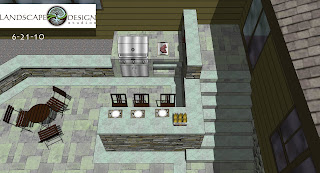
Here are snapshots of a few designs that I have been afforded by all of the rain:



There is a program on the DIY network that I have really enjoyed watching on Sunday afternoons (while designing something) called "Yard Crashers". What a great show, and what a truly great premise for a show!
The fact that it is on the DIY network (the "Do-It-Yourself network") and has a premise that people who are quite possibly fledgling away at their own landscape improvement projects might benefit significantly from the aid of a true team of professionals is an awesome thing to see.
The "client prospects" are found drifting through their local supply stores, with the look of bewilderment as they try to piece together their own landscape projects. They often have very lofty ambitions and are maybe are even off to a respectable and decent start, but they just seem to have gotten into a rut or have more than they might be able to handle as a "weekend warrior".
These people are stalked and accosted by the host, Ahmed Hassan, who is a great character as he amusingly trails these people and practically begs them for his help. Whether these people are "in-tune" with the actual premise of the show or not, I am not sure. From my experience with "Curb Appeal" on HGTV in 2007, there might be just a hint of premeditated (or post-scripted) story built into it. But is seems like the real deal, where these people finally succumb to the idea that they need help and invite him (and the camera crew) over for a look.
Upon arrival, he gets the tour and clues them in that he has an arsenal of talent and production crew ready to full-on attack their project with aggressive landscaping, at no expense to them. By which, these people are surprised and are "like... okay, go for it!" with a lot of amusing banter from the host. Ahmed really does a nice job with this role and is a seemingly knowledgeable and engaging character with the client subjects, and does have some spot-on information that he provides them with as they look over the project and what could lie ahead for them.
So, the premise then starts to merge into the "Extreme Makeover: Home Edition" scenario where a large team of designers, contractors, installers, vendors, etc. shows up the next day (or what is supposed to be the next day) and brings them out of the house bright and early to overwhelm them with the great design ideas, and a load of talent and workforce in store for them on their project.
The designs seem utilitarian but do contain a lot of creativity, and are seemingly largely embellished versions of what the homeowner had set out to do, but were floundering away with it. Again, it is a great premise that can often echo what goes on in the "real world" and does seem to be a very genuine conversation and presentation for the client.
The team gets ready and the commences with the construction, with skid loaders and shovels flying everywhere, much like Extreme Home Makeover. However, Ahmed, the host, constantly walks side-by-side with the clients, and sets them up with all sorts of "tasks" to do throughout the project. The clients are digging holes, installing base, splitting block, screeding sand, running a table saw, screwing fasteners into a pergola, or whatever it takes to help the production team, while the host acts as their "personal trainer" through the process. He is almost like a trainer at the gym setting them up to do their third set of bench press, or is a chef running a cooking class with them or something, and does a very nice job with it.
Then, as they proceed to their get bulk materials delivered to them (for free) from Unilock Pavers, or a from the local appliance store, or from a lumber yard, he builds incentives into the situation for them, like "well, if you help out with the installation of these pavers, then we will give you the new stainless steel grill that goes on top of it, which is in this box right here," as he continues motivate the client into getting the project done in a short amount of time. Whether it truly is "two days" or not remains to be realistic, but it does seem to happen in a short duration of time.
Again, it is a really good premise for a show, and does show the "DIY" landscaper or "weekend warrior" that if you do get the assistance of a professional designer and professional installation team, then you will get way more than you ever could imagine, or would manage to complete yourself. It shows that landscaping has all kinds of technical aspects to it that could best be put in professional hands....And best of all, in the end, you will be enormously much happier with the results once they are completed..
It might just be one of my new favorite shows and fits in very nicely as a Sunday afternoon lead-in to Extreme Makeover: Home Edition, which is still such a great show for a family to sit down and watch (while I am designing something), in my opinion. I love the philanthropic side to that show, the community support, the generosity of the builders and vendors who participate, and the hero that is inside of the people who are seeing their problems abated by a new home, and some of their wildest dreams become a reality in the form of really amazing design ideas. It is a show that hopefully will stand the test of time and carry-on for years to come.
Anyway, one key quote from Ahmed Hassan that I took from a recent episode of "Yard Crashers" is this: "There is only one rule when it comes to landscaping in the rain..... Don't Do it!".
Very sound advice, my friend. I have tried to explain this to several impatient clients in the past, but not so effectively. There is such a thing as "collateral damage" in landscaping, where you make a more of a mess than what you actually improve. That is the hidden beast in this profession from time to time. Unfortunately, it has been raining a lot lately here and that is probably the best rule to live by.... for a little while, at least. Those graduation parties aren't going to be postponed, however.
The point is, if you are reading this... please hire a professional designer, such as us at Landscape Design Studios, to make the very most of your project. And, please be patient if we get a lot of rain and have to wait it out for a little while.
Here are snapshots of a few designs that I have been afforded by all of the rain:


Best of Luck!
Dave
Subscribe to:
Posts (Atom)