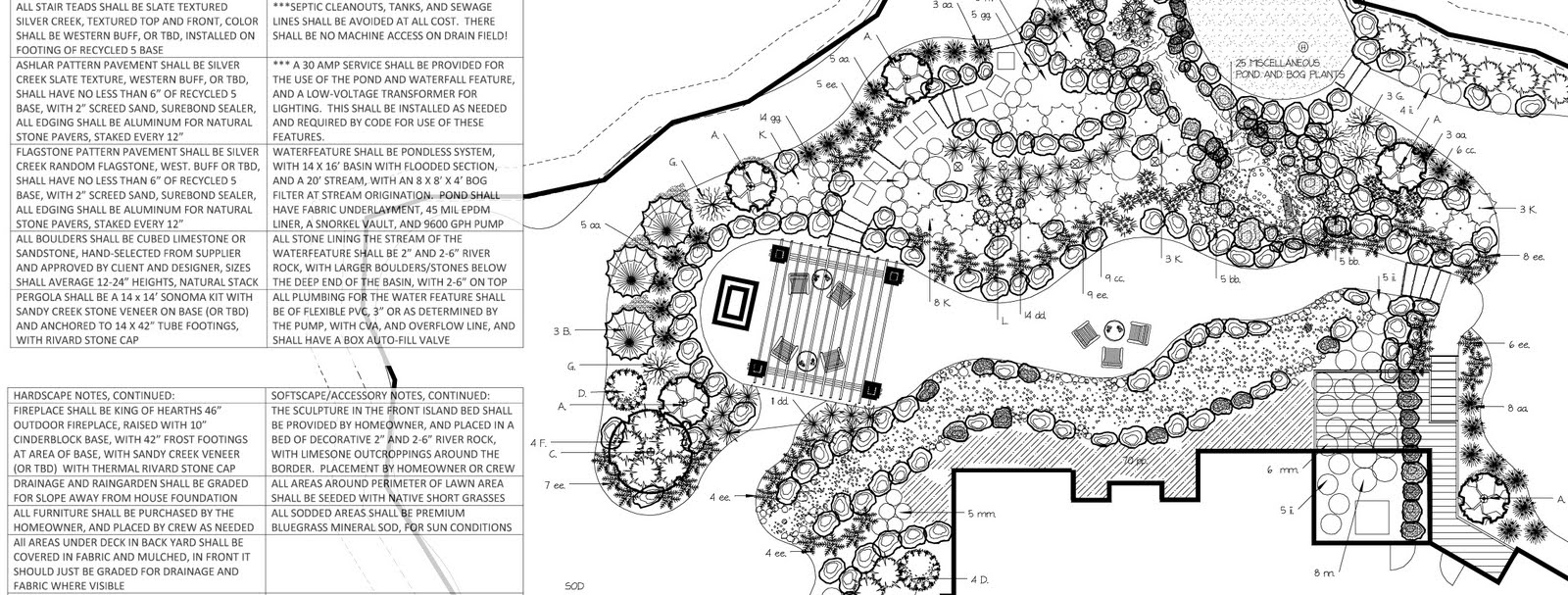
So... back to "The Landscaper's Challenge" concept, which the HGTV that we all know and love (most of the time) has introduced to us homeowners as a good way to gather competing designs, meticulously and thoroughly thought through by each professional landscape designer, as sort of a reality show that we could host on our own dining room table, as a way to select and award the "best desginer." Well, there are definitely a few problems with that concept....
1. Sometimes the "landscaper's challenge" brings the TMI factor, the "too much information" for you to consider in the process, with a lot of the information or ideas getting thrown out, which results in some uneccessary expenditures of everyone's time involved. In addition to the designer's time, this definitely includes your own precious time. Every design has options to consider, and now you will be factoring these options x 2, 4, or 6, or more! How much time do you really want to waste thinking over and factoring in some mediocre to bad options that could be included, that will ultimately need to get thrown out for better options, with too many options now muddling up the decision.
2. The "TMGI" factor. The "too many good ideas" problem that also might come out of this will cause the client to want to combine and synergize several design ideas into one project, often to the level where the design turns into a mish-mash. Again, every great feature doesn't always belong within one landscape. There is such a thing as a "clutter" in the landscape. Also, the time spent revising the plan, then revising the estimate, then revising the plan, then revising the estimate, then... again, again, again, can be counterproductive as well. And that targeted budget that you had set aside might no longer be attainable at all,with all of the things being added and subtracted.
3. There is also the time vaccum in the time-value continuum, where any designer who needs to earn a living and support a family in a seasonal industry can not afford to craft the perfect design for 12-15+ hours for free. Instead, they might "throw things together" and the design is not at the level it could be, or is way too ambiguous to start. Anyone who is busy is probably *good* or at least might likely be *better* than the ones who have much more idle time to donate for their services. Anyone who is donating lots of time will likely expect to reap more than the usual amount of money from the project. Landscapers, or landscape designers don't get rich, nor they should not really plan to get rich on one or two projects instead of 10 or 15.
4. With the lack of a more *genuine personal connection* and commitment between you and any one particular designer, there are some personal-level details and design touches which don't get into the design. When one designer makes a connection and is able to communicate and relate with you, well... that is good! You could be spending *a lot* of time with them in the future, possibly even seeing them at times years after. Landscapes are things that grow and evolve, and often even look their best three years later. It is good to make a connection and a friend out of your designer. This is why I sometimes get hugs from a few clients when I go out to visit. We've been through a lot together and they have become my friends. ....It is an on-going relationship.
The point of this is to make the suggestion that you host a thorough interview and discuss your project in a systematic process that will identify who is best for you. Rather than try to host "the Landscaper's Challenge", I would host an interview with the three people you are considering, which focuses on *your needs*, and then their work history, their skills, their references, and how well you and the designer can connect and are able to communicate and relate with each other. Again, you could be spending *a lot* of time, and maybe *a lot* of money, with them in the future.
But, if you do happen to host Landscaper's Challenge on a major network, like HGTV, to give each designer the chance to do the project and be on national television showcasing their work. Then, I will gladly do a "Landscaper's Challenge" without hesitation. The HGTV "Curb Appeal" show was not so bad, it was actually pretty fun working with the clients and the production crew, but was a bit stressful. I think I did lose some of my hair in the process and the camera added about 15 lbs. Here is the link to that episode (hopefully they will post a partial video clip of it in the future):
http://www.hgtv.com/curb-appeal/change-for-a-classic-colonial/index.html
Best of luck!
DS
Landscape Design Studios, "Inside the Studio" -- The official "Design Journal" of Landscape Design Studios LLC, as maintained by David Sonka on behalf of Jack Dorcey and our company. I hope to show you, our friends, family, and clients, some snapshots of our work through the progression of the landscape season, and the questions and answers that arise in the process of being a professional landscape designer.
Saturday, April 17, 2010
The Time - Value Continuum
Here is a sample graphic I did for my first "really big project" back in 2000.
In ten years, a lot has changed.
There are these things that I have been wondering for the past few years about time and value. If I may, I would like to ask you (any reader of this, now or in the future) for your help with some answers. I know I don't have any real "followers" on here. But hopefully through Facebook and the potential HGTV enthusiasts, or the weekend-warrior homeowners who might be out there, or even the fellow landscape professionals out there who might be able to offer some valuable advice through any of these channels. I would appreciated any bits of good feedback. Let's imagine for a moment...
*cue the harp music and dream imagery*
We are in the year 2010. Let's imagine you are a homeowner with a "diamond in the rough" property, and have set aside a budget of $100,000 to invest into a well-conceived landscape for you, your family, and friends to enjoy over the next ten years. It might include things such as a pool, pond, or outdoor living space with some features that you have been dreaming about to enjoy in your time outdoors. You have the funds and you have some ideas, but need to have them crafted into the ultimate design that will skillfully include all of the features you desire. So.... you need a design, and you need a good designer.
Well, of course I always aspire to be that designer for you to call, and hopefully you will call me. So, let's say that you do, and you happen to call one or two other possible designers. Here it is, the "Landscaper's Challenge", which always sounds good in theory, but could often become a waste of time and delay the process of getting your work done. (I thought about rambling on this for a moment, but please refer to the next blog post for an explanation.) Anyway, sorry for the tangent...
Back to the time-value continuum. So I have some different design tools to offer you in the process of creating your $100,000 landscape. Each of these tools takes a certain amount of time to use in perparation of your plans, and each tool is effective in certain ways, some more than others. But if I could ask for your advice, which tools are most and least effective, and how much might you think is reasonable to spend on each type of design tool, to get the design that you really want...
So, you start with some type of nice plan layout.... and you ask: "what is this supposed to look like?"
Here are some options:
Case 1. Hand-drawn graphics/sketches used to supplement a landscape plan.
C. $500 - $750
D. $750 - $1,000
E. $1,000-$1,250
F. $1,250 - $1,500
G. Nothing
3. How effective is this to you?
A. Very!
B. It helps, I would pay for this.
C. It is not really necessary, or I would not pay for it.
4. How much would this graphic be worth to you?
A. $100 - $250
B. $250 - $500
C. $500 - $750
D. $750 - $1,000
E. $1,000-$1,250
F. $1,250 - $1,500
G. Nothing
Case 3: Computer Photo-Imaging.
A. Very!
B. It helps, I would pay for this.
C. It is not really necessary, or I would not pay for it.
6. How much would this graphic be worth to you?
A. $100 - $250
B. $250 - $500
C. $500 - $750
D. $750 - $1,000
E. $1,000-$1,250
F. $1,250 - $1,500
G. Nothing
Case 4: Computer-Imaging, to the Extreme.
7. How effective is this to you?
A. Very!
B. It helps, I would pay for this.
C. It is not really necessary, or I would not pay for it.
8. How much would this graphic be worth to you?
A. $250 - $500
B. $500 - $750
C. $750 - $1,000
D. $1,000-$1,250
E. $1,250 - $1,500
F. $1,500 - $1,750
G. $1,750 - $2,000
H. $2,000 or more is definitely justifiable.
H. Nothing
Each one of these are tools is effective in showing people their design, while allowing them to particicpate in the design process as they viusalize the finished project. However, there are significant differences in how much time each of these techniques will typically require. A case can be made that the lastest/greatest and most time-consuming techniques used to illustrate a design are not the best and most cost-effective methods to use. Their could be a case made for the old hand-drawn illustrations as the best method for design graphics, depending on how much people want to invest in their design and what they need to see, as they don't always take such an enormous amount of time.
Hmmm, but it is great to be able to say: "let me show you what this stone paver will look like on your terrace."
Whatever answers or feedback you can provide are greatly appreciated!
***If you answer all of these and send them to me at: Dave@landscapedesignstudios.com along with whatever feedback you have, I will offer you $100 off of any design work you need.***
In ten years, a lot has changed.
There are these things that I have been wondering for the past few years about time and value. If I may, I would like to ask you (any reader of this, now or in the future) for your help with some answers. I know I don't have any real "followers" on here. But hopefully through Facebook and the potential HGTV enthusiasts, or the weekend-warrior homeowners who might be out there, or even the fellow landscape professionals out there who might be able to offer some valuable advice through any of these channels. I would appreciated any bits of good feedback. Let's imagine for a moment...
*cue the harp music and dream imagery*
We are in the year 2010. Let's imagine you are a homeowner with a "diamond in the rough" property, and have set aside a budget of $100,000 to invest into a well-conceived landscape for you, your family, and friends to enjoy over the next ten years. It might include things such as a pool, pond, or outdoor living space with some features that you have been dreaming about to enjoy in your time outdoors. You have the funds and you have some ideas, but need to have them crafted into the ultimate design that will skillfully include all of the features you desire. So.... you need a design, and you need a good designer.
Well, of course I always aspire to be that designer for you to call, and hopefully you will call me. So, let's say that you do, and you happen to call one or two other possible designers. Here it is, the "Landscaper's Challenge", which always sounds good in theory, but could often become a waste of time and delay the process of getting your work done. (I thought about rambling on this for a moment, but please refer to the next blog post for an explanation.) Anyway, sorry for the tangent...
Back to the time-value continuum. So I have some different design tools to offer you in the process of creating your $100,000 landscape. Each of these tools takes a certain amount of time to use in perparation of your plans, and each tool is effective in certain ways, some more than others. But if I could ask for your advice, which tools are most and least effective, and how much might you think is reasonable to spend on each type of design tool, to get the design that you really want...
So, you start with some type of nice plan layout.... and you ask: "what is this supposed to look like?"
Here are some options:
Case 1. Hand-drawn graphics/sketches used to supplement a landscape plan.
1. How effective is this to you?
A. Very!
B. It helps, I would pay for this.
C. It is not really necessary, or I would not pay for it.
2. How much would this (type of) graphic be worth to you?
A. $100 - $250
B. $250 - $500C. $500 - $750
D. $750 - $1,000
E. $1,000-$1,250
F. $1,250 - $1,500
G. Nothing
Case 2: Larger-Scale hand-drawn graphics/sketches used to supplement a landscape plan.
3. How effective is this to you?
A. Very!
B. It helps, I would pay for this.
C. It is not really necessary, or I would not pay for it.
4. How much would this graphic be worth to you?
A. $100 - $250
B. $250 - $500
C. $500 - $750
D. $750 - $1,000
E. $1,000-$1,250
F. $1,250 - $1,500
G. Nothing
Case 3: Computer Photo-Imaging.
5. How effective is this to you?
A. Very!
B. It helps, I would pay for this.
C. It is not really necessary, or I would not pay for it.
6. How much would this graphic be worth to you?
A. $100 - $250
B. $250 - $500
C. $500 - $750
D. $750 - $1,000
E. $1,000-$1,250
F. $1,250 - $1,500
G. Nothing
Case 4: Computer-Imaging, to the Extreme.
A. Very!
B. It helps, I would pay for this.
C. It is not really necessary, or I would not pay for it.
8. How much would this graphic be worth to you?
A. $250 - $500
B. $500 - $750
C. $750 - $1,000
D. $1,000-$1,250
E. $1,250 - $1,500
F. $1,500 - $1,750
G. $1,750 - $2,000
H. $2,000 or more is definitely justifiable.
H. Nothing
Each one of these are tools is effective in showing people their design, while allowing them to particicpate in the design process as they viusalize the finished project. However, there are significant differences in how much time each of these techniques will typically require. A case can be made that the lastest/greatest and most time-consuming techniques used to illustrate a design are not the best and most cost-effective methods to use. Their could be a case made for the old hand-drawn illustrations as the best method for design graphics, depending on how much people want to invest in their design and what they need to see, as they don't always take such an enormous amount of time.
Hmmm, but it is great to be able to say: "let me show you what this stone paver will look like on your terrace."
Whatever answers or feedback you can provide are greatly appreciated!
***If you answer all of these and send them to me at: Dave@landscapedesignstudios.com along with whatever feedback you have, I will offer you $100 off of any design work you need.***
Tuesday, April 6, 2010
Time to Play Ball!
For me, growing up in Iowa with summer baseball, watching movies like The Natural, Field of Dreams, Bull Durham, Major League, and the original Bad News Bears with Walter Matthau... and, periodically heading to various major league ballparks around the midwest when I wasn't actually playing it or watching it at the local level... the start of baseball season was the beginning of spring and the signal that the summer days were imminent. Today is that day, and the dog days of summer are not far ahead.
While I was not, and am not now, the baseball player I dreamed of becoming, it is nice to live in a cycle that is paralleled by the baseball season. It seems that the landscape season in Minnesota largely follows the same path and routine as that of a professional ball player. There are the winter days off, taking some time off but continuing to sharpen the skills and study the game. The spring training begins with some design work and taking training programs that the MNLA or other associations and vendors put on in January, February, and March. Then, the season arrives at the first burst of spring-like weather, when it seems the snow is behind us and the more temperate weather is here to stay. The time spent outdoors in the field starts to increase week by week. Then, the season takes speed and is a fury of going place to place to place, with lots of travel and lots of time logged into the computer doing CAD drawings and making correspondence. Hopefully, by the latter part of the season, the rewards are coming in with a good base of business and success that can get you through the month of October and early November. And, hopefully, by the time that the decline in the cold darkness of winter dormancy arrives, when it is time to retreat indoors, there is a level of satisfaction and reward with how the season had ended. This happens just as the major league baseball champions are crowned. Finally, it is time to relax and reflect, and gradually plan out the strategies of the next season. And, ultimately, the cycle begins all over again.
The big difference, of course, is that I do not get paid anything like a professional ball player. Not just in terms of money, but also in terms of salary versus performance-based income. If only players could get paid based on the number of wins they have, or RBIs, or put-outs, or pitching victories they attain. Or, better yet, if only I could get paid a guranteed salary whether or not I produce it, and can be paid handsomely for endorsements. Then, we'd really be talking parallel.
One of the programs that I love playing with and can use effectively is Google SketchUp. It is a pretty versatile software which allows mockups of certain ideas, as well as more thorough studies of spaces and structures, with a level of illustration that is effective for putting clients into their design . It is something that is not for every client or every project, but when used and blended with other conventional design techniques, it can be very useful and helpful. It can bring out the masochist in you, and can be about as addictive as getting immersed in a video game and trying to get to that next level. But it allows clients to really see and preview aspects of their design.
Here are some examples of how I use SketchUp, which are additional to the models of a project shown in previous posts.
Here are the seats that I will be sitting in at Target Field, the new home of the Minnesota Twins, this summer. This model was created by "makikalem" on SketchUp. Just when I think that I am being a masochist, I see models like this, or the Eiffel Tower, and realize that maybe I am not alone in my SketchUp addiction.
First Game Seats:
While I was not, and am not now, the baseball player I dreamed of becoming, it is nice to live in a cycle that is paralleled by the baseball season. It seems that the landscape season in Minnesota largely follows the same path and routine as that of a professional ball player. There are the winter days off, taking some time off but continuing to sharpen the skills and study the game. The spring training begins with some design work and taking training programs that the MNLA or other associations and vendors put on in January, February, and March. Then, the season arrives at the first burst of spring-like weather, when it seems the snow is behind us and the more temperate weather is here to stay. The time spent outdoors in the field starts to increase week by week. Then, the season takes speed and is a fury of going place to place to place, with lots of travel and lots of time logged into the computer doing CAD drawings and making correspondence. Hopefully, by the latter part of the season, the rewards are coming in with a good base of business and success that can get you through the month of October and early November. And, hopefully, by the time that the decline in the cold darkness of winter dormancy arrives, when it is time to retreat indoors, there is a level of satisfaction and reward with how the season had ended. This happens just as the major league baseball champions are crowned. Finally, it is time to relax and reflect, and gradually plan out the strategies of the next season. And, ultimately, the cycle begins all over again.
The big difference, of course, is that I do not get paid anything like a professional ball player. Not just in terms of money, but also in terms of salary versus performance-based income. If only players could get paid based on the number of wins they have, or RBIs, or put-outs, or pitching victories they attain. Or, better yet, if only I could get paid a guranteed salary whether or not I produce it, and can be paid handsomely for endorsements. Then, we'd really be talking parallel.
One of the programs that I love playing with and can use effectively is Google SketchUp. It is a pretty versatile software which allows mockups of certain ideas, as well as more thorough studies of spaces and structures, with a level of illustration that is effective for putting clients into their design . It is something that is not for every client or every project, but when used and blended with other conventional design techniques, it can be very useful and helpful. It can bring out the masochist in you, and can be about as addictive as getting immersed in a video game and trying to get to that next level. But it allows clients to really see and preview aspects of their design.
Here are some examples of how I use SketchUp, which are additional to the models of a project shown in previous posts.
Here are the seats that I will be sitting in at Target Field, the new home of the Minnesota Twins, this summer. This model was created by "makikalem" on SketchUp. Just when I think that I am being a masochist, I see models like this, or the Eiffel Tower, and realize that maybe I am not alone in my SketchUp addiction.
First Game Seats:
Second Game Seats:
The Concourse:
The Ballpark from above:
Wednesday, March 31, 2010
Mild March Madness
Did you know that this was the first March in recorded history that Minnesota (and parts beyond) did not receive a single flake of snow? In fact, we have not officially had any snow since Valentine’s Day (which I remember vividly as I drove through it on the way back from a nice date with my wife in St. Cloud.) But other than that, it has been a rather unique and unseasonable March, in a good way, that is.
At least, that's how it has been for us up here on the northern hinterland. Judging from the Facebook photos I have seen from my relatives as far south as Arkansas, Missouri, and even in other places around of the Southeast, they all got their fluke“snowball’s chance in h*ll” snowstorm once, twice, or maybe even three times this year, with the last one being in March. Go figure.
Well, most everyone who filled out an NCAA bracket probably saw their bracket crumble, and may have scored their all-time lowest point totals in recorded history at the hands of the UNI Panthers, Butler, and St. Mary’s. Now, the Final Four has been set and we enter into April tomorrow with 77 degree temperatures. It is time to start preparing for getting the spring landscape up and ready to grow.
There are a few items that could be looked at and addressed in promoting healthy lawns and gardens this April, and help them to get off to a good start and look their best in 2010:
- If you are inclined, dethatch and remove the old leaf litter, infected lawn, and any debris from the previous season. Go ahead and overseed if you would like. Aerate if you would like. If you are overseeding and want to stop crabgrass, you must use a special type of pre-emergent herbicide called Treble, which won't harm the good seed. Otherwise, you can apply a pre-emergent Crabgrass herbicide with fertilizer to lawns to control annual crabgrass, usually around mid-month when soil temperatures reach 55 degrees and Forsythia is in bloom.
- Dig the mulch from around your perennials a little and watch them come through. Consider adding some compost or organic matter around them. You can Apply Preen or Treflan, or use Corn Gluten Meal if you want more of an eco-friendly choice, to the landscape beds to control annual weeds. Existing weeds can be pulled, or sprayed with Round-up (make sure to follow manufacture's instructions).
- Go ahead and fertilize trees, shrubs, and evergreens.
- Go ahead and spray fruiting trees, like crabapple and hawthorn trees with dormant spray.
Get ready to watch the leaves bud out, and the flowers, bulbs, and spring bloomers come out and bloom.
And, if the NCAA Brackets are at all salvageable, or if you feel the same way I do about college basketball..... please, please, please don’t let DUKE win the NCAA Championship this year!
At least, that's how it has been for us up here on the northern hinterland. Judging from the Facebook photos I have seen from my relatives as far south as Arkansas, Missouri, and even in other places around of the Southeast, they all got their fluke“snowball’s chance in h*ll” snowstorm once, twice, or maybe even three times this year, with the last one being in March. Go figure.
Well, most everyone who filled out an NCAA bracket probably saw their bracket crumble, and may have scored their all-time lowest point totals in recorded history at the hands of the UNI Panthers, Butler, and St. Mary’s. Now, the Final Four has been set and we enter into April tomorrow with 77 degree temperatures. It is time to start preparing for getting the spring landscape up and ready to grow.
There are a few items that could be looked at and addressed in promoting healthy lawns and gardens this April, and help them to get off to a good start and look their best in 2010:
- If you are inclined, dethatch and remove the old leaf litter, infected lawn, and any debris from the previous season. Go ahead and overseed if you would like. Aerate if you would like. If you are overseeding and want to stop crabgrass, you must use a special type of pre-emergent herbicide called Treble, which won't harm the good seed. Otherwise, you can apply a pre-emergent Crabgrass herbicide with fertilizer to lawns to control annual crabgrass, usually around mid-month when soil temperatures reach 55 degrees and Forsythia is in bloom.
- Dig the mulch from around your perennials a little and watch them come through. Consider adding some compost or organic matter around them. You can Apply Preen or Treflan, or use Corn Gluten Meal if you want more of an eco-friendly choice, to the landscape beds to control annual weeds. Existing weeds can be pulled, or sprayed with Round-up (make sure to follow manufacture's instructions).
- Go ahead and fertilize trees, shrubs, and evergreens.
- Go ahead and spray fruiting trees, like crabapple and hawthorn trees with dormant spray.
Get ready to watch the leaves bud out, and the flowers, bulbs, and spring bloomers come out and bloom.
And, if the NCAA Brackets are at all salvageable, or if you feel the same way I do about college basketball..... please, please, please don’t let DUKE win the NCAA Championship this year!
Tuesday, March 23, 2010
Spring Things – Beyond the Spring Equinox
Happy Spring! The dirty brown piles of snow are all but gone. The sun now rises just after 7 AM and sets just before 7:30 PM. The robins have returned. The red maples are blooming. The crocus flowers, tulips, and other spring bulbs are showing signs of life to make their appearance for a brighter spring. All things begin anew in the landscape. The Minnesota Twins are playing ball in Fort Meyers. Joe Mauer is secured to an 8-year contract extension. The chalk lines on the green grass of the new ballpark are about to be set. The landscape trucks have removed their snow plows (hopefully for good) as they prepare for the coming season. The new season is drawing near.
In preparation for the new growing season, and as landscaping season begins, here are some tips on things to do in the yard as you go outside to get some fresh air:
- Prune trees and summer-flowering shrubs (flowers on new growth after mid June) while still dormant. You have about a week to prune oaks, if you absolutely must, before the running the risk of oak wilt, although it is much easier to identify the dead wood to prune in the late fall.
- If needed, rejuvenate prune shrubs such Japanese and bumald spirea varieties, honeysuckle, smokebush, red twig dogwood, burning bush, and a few others within the next week or so.
- Cut back ornamental grasses to 3” and clear other perennial remnants from the fall, to clear the way for the new growth of newly emerging perennials.
- Plants to refrain from pruning until after bloom: azalea, rhododendron, bridal wreath spirea, crabapple, lilac, chokeberry, magnolia, serviceberry, mockorange, forsythia, sandcherry, and most hydrangeas.
- Rake the yard when it is dry enough, and inspect it for evidence of ailments such as snow mold and lawn fungus, and remove the residues of your beloved pet. Consider the need for dethatching, aerating, and needing to patch or reseed lawn areas as the overnight temperatures continue to rise toward 45-50 degrees. Consider whether to apply a type of pre-emergent or post-emergent weed control measure as you head into the month of April, whether you need to re-seed parts of your lawn will help influence this decision on when and what to use.
- Begin your landscape plans!
(cue the segue…)
It is a good idea to have a landscape professional consult with you, as you review the needs of your property and consider all of your landscape’s potential for 2010. Landscape Design can bring your property to its fullest potential and achieve its fullest value, and maximize the enjoyment that you, your friends, and your family will have at your home. It adds “virtual square footage” to your home and provides a custom outdoor setting where you can experience three of Minnesota’s best seasons in the beauty of the outdoors.
Once again, that’s what Jack and I at Landscape Design Studios are here for. We have the tools and the skills to show the full potential of your own outdoors, and we have a group of amazing professionals to make this potential a magnificent reality. Please call us and let us show you what we can do to customize your outdoor experience. Visit us at http://www.landscapedesignstudios.com/.
…And I certainly look forward to doing this over the next 8 years while watching Joe Mauer batting for the MinnsesotaTwins in their new magnificent, custom outdoor ballpark.
-DS
In preparation for the new growing season, and as landscaping season begins, here are some tips on things to do in the yard as you go outside to get some fresh air:
- Prune trees and summer-flowering shrubs (flowers on new growth after mid June) while still dormant. You have about a week to prune oaks, if you absolutely must, before the running the risk of oak wilt, although it is much easier to identify the dead wood to prune in the late fall.
- If needed, rejuvenate prune shrubs such Japanese and bumald spirea varieties, honeysuckle, smokebush, red twig dogwood, burning bush, and a few others within the next week or so.
- Cut back ornamental grasses to 3” and clear other perennial remnants from the fall, to clear the way for the new growth of newly emerging perennials.
- Plants to refrain from pruning until after bloom: azalea, rhododendron, bridal wreath spirea, crabapple, lilac, chokeberry, magnolia, serviceberry, mockorange, forsythia, sandcherry, and most hydrangeas.
- Rake the yard when it is dry enough, and inspect it for evidence of ailments such as snow mold and lawn fungus, and remove the residues of your beloved pet. Consider the need for dethatching, aerating, and needing to patch or reseed lawn areas as the overnight temperatures continue to rise toward 45-50 degrees. Consider whether to apply a type of pre-emergent or post-emergent weed control measure as you head into the month of April, whether you need to re-seed parts of your lawn will help influence this decision on when and what to use.
- Begin your landscape plans!
(cue the segue…)
It is a good idea to have a landscape professional consult with you, as you review the needs of your property and consider all of your landscape’s potential for 2010. Landscape Design can bring your property to its fullest potential and achieve its fullest value, and maximize the enjoyment that you, your friends, and your family will have at your home. It adds “virtual square footage” to your home and provides a custom outdoor setting where you can experience three of Minnesota’s best seasons in the beauty of the outdoors.
Once again, that’s what Jack and I at Landscape Design Studios are here for. We have the tools and the skills to show the full potential of your own outdoors, and we have a group of amazing professionals to make this potential a magnificent reality. Please call us and let us show you what we can do to customize your outdoor experience. Visit us at http://www.landscapedesignstudios.com/.
…And I certainly look forward to doing this over the next 8 years while watching Joe Mauer batting for the MinnsesotaTwins in their new magnificent, custom outdoor ballpark.
-DS
Red Maple Blooms.
Mad CAD skills.
Getting the big hits!
Wednesday, March 10, 2010
The Big Thaw. Then...The Big Push.
Aboard the U.S.S. Enterprise of “Landscape Design Studios”, watching the slow and steady 40-degree rain melt away the snow. With the rain and “warmer” temperatures, my pristine 8.5’ mountain of snow off the driveway is now a dwindling, dirty-brown mound of about 3’ tall. It is amazing to see that the grass being revealed under the snow is already a pleasant shade of green. With some phone calls and emails going out to clients and prospects, as the glacier of snow over Minnesota melts away and the green grass is revealed, it will not be long before the “The Big Push” is on. It will be time to hit the thrusters and prepare for *warp speed*.
So far, my role involves writing thorough proposal descriptions for my clients, with lots of facts and adjectives on what I can and will do for them, on what their designs can be, and how I (we) can differentiate myself (ourselves) from the rest of the pack. (There are clear differences on how we can be our client’s best advocate, and offer them great pricing.)
Also, as a Designer for my clients, I have been set with the task to “make the snow disappear” and clearly illustrate their landscape and remodeling ideas for them, in spite of the winter landscape. It requires some different techniques to make this possible. Sometimes, it is just as simple as a plan and a few good sketches. But I like to make things as vivid and illustrative as possible for my clients, whenever I can.
This can bring out the stubborn perfectionist and masochist in me. Kind of like when I was a kid in 2nd grade, when I had to spend a long winter inside with a broken leg. (I broke my leg in a sledding accident, after building a "bobsled course" through the woods behind my house. I flew off course and hit a tree, really hard. Thus, ending my shot at a medal in the Olympics.) With a cast on my leg, I would sit perched in front of my Atari system for hours and hours, trying to master Space Invaders or Asteroids, until I could get that score as high as possible to where I would finally feel content. Usually, that was also when my fingers and thumbs hurt, and my eyes ached from sitting in front of the screen for so long.
Now, I find myself sitting in front of my computer in the same pose, with the need to make a living and support the family, working meticulously through the design idea and creating the “scene” until it is reasonably “perfect”. Usually, that is also when my fingers, thumbs, and eyes ache, and I need to finally get myself to bed. (I knew that all of those Atari games I played as a kid would be good for something!)
The objective now is to help articulate the design as well as possible, and allow my clients to “see” their actual project, with their actual home, and with their actual landscape in some context of its full glory.
1. Here is an example of a front yard terraced hillside and planting design I recently finished. The goal was to remove the lawn hillside and most all of the lawn from their front yard, including the city right-of-way, and replace it with garden space. They want a small space to sit in their front yard, a functional lawn corridor through the landscape, and to have plenty of places to plant a lot of vibrant plants in somewhat of a contemporary style. So, this is how I revealed the landscape plan, in spite of all the snow cover.
2. Here is an example of an “up north” property that is to be remodeled and updated with a more beautiful and functional landscape, that takes it from a “2 star property” toward a “4 star property”. This one is still a WIP, and might be for a little while yet. But I am in the process of getting the “big picture” scene made, and getting the on-going dialogue with the client underway. (This seems like a really nice client, who I feel fortunate to have recently met. I love working for clients who are great people and make my work fun.)


I am ready to get to work. Now, what can I do for you?!
..........…Oh, and where is that new Joe Mauer contract?! (coming up next.)
So far, my role involves writing thorough proposal descriptions for my clients, with lots of facts and adjectives on what I can and will do for them, on what their designs can be, and how I (we) can differentiate myself (ourselves) from the rest of the pack. (There are clear differences on how we can be our client’s best advocate, and offer them great pricing.)
Also, as a Designer for my clients, I have been set with the task to “make the snow disappear” and clearly illustrate their landscape and remodeling ideas for them, in spite of the winter landscape. It requires some different techniques to make this possible. Sometimes, it is just as simple as a plan and a few good sketches. But I like to make things as vivid and illustrative as possible for my clients, whenever I can.
This can bring out the stubborn perfectionist and masochist in me. Kind of like when I was a kid in 2nd grade, when I had to spend a long winter inside with a broken leg. (I broke my leg in a sledding accident, after building a "bobsled course" through the woods behind my house. I flew off course and hit a tree, really hard. Thus, ending my shot at a medal in the Olympics.) With a cast on my leg, I would sit perched in front of my Atari system for hours and hours, trying to master Space Invaders or Asteroids, until I could get that score as high as possible to where I would finally feel content. Usually, that was also when my fingers and thumbs hurt, and my eyes ached from sitting in front of the screen for so long.
Now, I find myself sitting in front of my computer in the same pose, with the need to make a living and support the family, working meticulously through the design idea and creating the “scene” until it is reasonably “perfect”. Usually, that is also when my fingers, thumbs, and eyes ache, and I need to finally get myself to bed. (I knew that all of those Atari games I played as a kid would be good for something!)
The objective now is to help articulate the design as well as possible, and allow my clients to “see” their actual project, with their actual home, and with their actual landscape in some context of its full glory.
1. Here is an example of a front yard terraced hillside and planting design I recently finished. The goal was to remove the lawn hillside and most all of the lawn from their front yard, including the city right-of-way, and replace it with garden space. They want a small space to sit in their front yard, a functional lawn corridor through the landscape, and to have plenty of places to plant a lot of vibrant plants in somewhat of a contemporary style. So, this is how I revealed the landscape plan, in spite of all the snow cover.
2. Here is an example of an “up north” property that is to be remodeled and updated with a more beautiful and functional landscape, that takes it from a “2 star property” toward a “4 star property”. This one is still a WIP, and might be for a little while yet. But I am in the process of getting the “big picture” scene made, and getting the on-going dialogue with the client underway. (This seems like a really nice client, who I feel fortunate to have recently met. I love working for clients who are great people and make my work fun.)


I am ready to get to work. Now, what can I do for you?!
..........…Oh, and where is that new Joe Mauer contract?! (coming up next.)
Tuesday, March 2, 2010
"Hitting the Ground Running"
This doesn't really follow the whole "launch into space" metaphor from the first post, but "Hitting the Ground Running" seems to fit appropriately. Maybe it should be "Hitting the Moon Running"? Or maybe the unexplored and new territories of Mars? This is all new and adventurous territory for us, being our own guys and making things happen.
Anyway, Jack and I had what seems to be a successful presence at the St. Paul Home and Patio Show, as well as the Minneapolis Home and Garden Show…which is great! It was good to meet new people, and was absolutely great see some old friends and family passing through. It was fun to feel like spring is just around the corner. Congratulations to Mr. Brudevold and Ms. Pampuch for winning free plans.
I am eager to get the spring season here, albeit a little on the gradual side, in order to ease into the demanding pace of dedicating ourselves to traveling for appointments and burying ourselves in designs and CAD drawings into the wee hours of the night, or maybe the early mornings in Jack’s case. It is always good to have spring come in a steady progression rather than just show up in the front yard one morning.
It is too early to tell, but 2010 and the pioneer voyage could be a fun and successful year. As our motto goes: “Design is our passion. Service is our solution.” We are now ready to deliver the service we have aspired to this year for our clients, to save them time and money, and put them in very capable and considerate hands. The many pages of our business plan describe it, and now we’re ready to execute it.
First, I will try to complete the plans that I have donated to fundraisers for different worthy causes; the nuns and consociates at St. Catherines, and an orphanage in Rwanda, and hope to proceed to get one that is on the table ready to go first thing this spring. Then, I will proceed to work on the potential graduation party project, the new construction home full of weeds and dirt, team up with a couple of other colleagues on certian projects, and visit the others who had given us snippets of information at the home shows. And off to the races we go!
Here are some samples of one of those potential projects, somewhat of a simpler project on an existing home, which I have illustrated to show how these spaces will work together.
Here’s is to making it a great year, and a year for getting what you need and a good portion of what you had hoped for! Cheers!


Anyway, Jack and I had what seems to be a successful presence at the St. Paul Home and Patio Show, as well as the Minneapolis Home and Garden Show…which is great! It was good to meet new people, and was absolutely great see some old friends and family passing through. It was fun to feel like spring is just around the corner. Congratulations to Mr. Brudevold and Ms. Pampuch for winning free plans.
I am eager to get the spring season here, albeit a little on the gradual side, in order to ease into the demanding pace of dedicating ourselves to traveling for appointments and burying ourselves in designs and CAD drawings into the wee hours of the night, or maybe the early mornings in Jack’s case. It is always good to have spring come in a steady progression rather than just show up in the front yard one morning.
It is too early to tell, but 2010 and the pioneer voyage could be a fun and successful year. As our motto goes: “Design is our passion. Service is our solution.” We are now ready to deliver the service we have aspired to this year for our clients, to save them time and money, and put them in very capable and considerate hands. The many pages of our business plan describe it, and now we’re ready to execute it.
First, I will try to complete the plans that I have donated to fundraisers for different worthy causes; the nuns and consociates at St. Catherines, and an orphanage in Rwanda, and hope to proceed to get one that is on the table ready to go first thing this spring. Then, I will proceed to work on the potential graduation party project, the new construction home full of weeds and dirt, team up with a couple of other colleagues on certian projects, and visit the others who had given us snippets of information at the home shows. And off to the races we go!
Here are some samples of one of those potential projects, somewhat of a simpler project on an existing home, which I have illustrated to show how these spaces will work together.
Here’s is to making it a great year, and a year for getting what you need and a good portion of what you had hoped for! Cheers!


Subscribe to:
Posts (Atom)